
Kingdom Vision of the Created World
Today's Reading:
Psalm 8:3–6
Ezekiel 28:13
Key Verse:
You made him little less than God and crowned him with glory and honor. You made him ruler over the works of your hands; you put everything under his feet. (Psalm 8:3-6)
Devotional
On Day 1 we saw the story of God building a place for His family, both divine and human, to live and from which to share in His reign as Adam and Eve spread the rule of God throughout the whole Earth. That's where we first see the idea of a "Sacred Space", a space where heaven and earth literally occupy the same space. (HINT: We'll see more of this as the study continues)
It's easy to think of God and the Heavenly Hosts as far removed from us mere mortals. It seems natural to classify ourselves as utterly insignificant in contrast to the glory and holiness of God, but that's not what Scripture frames for us in these passages. Yes, He did make us "a little lower than God" or in other places, "a little lower than the angels", but that isn't to say He didn't (and doesn't) have big plans for us.
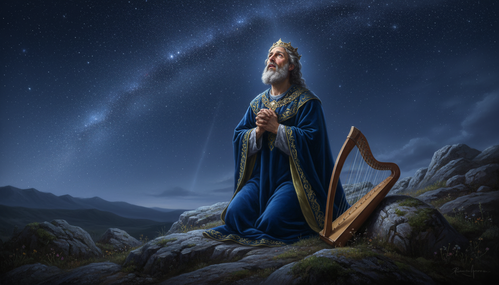
To properly frame these passages, and the worldview they represent, we have to look beyond material reality. Psalm 8 invites us to make that shift of vision. David didn't view humanity as small and meaningless as he gazed to the sky, he sees men and women through God's eyes; crowned with glory, commissioned with monumental purpose, and drawn into divine partnership.
And this truth astounded him.
This isn't poetic exaggeration or a literary device. In the Bible’s worldview, heaven and earth are one integrated realm under God’s rule, populated by both divine and human members of His family.
The phrase “crowned with glory and honor” is language the Hebrew Scriptures use for the heavenly beings who surround God’s throne. By applying it to humanity, David shows that humans were created to share in that royal-council vocation; earthly priests mirroring the heavenly order.
Ezekiel 28 reinforces that picture. The prophet’s vision of Eden glimmers with gems, fire, and mountain imagery, which is the design language of the divine council sanctuary, as some scholars describe it. Eden wasn’t merely a botanical paradise; it was God’s throne room extended into material creation, where His heavenly and earthly families coexisted.
This truth reframes our entire sense of purpose and existence. Modern scientific culture tells us we are products of chance, building our own meaning at ground level. But Scripture teaches we inhabit a spiritual ecology: a ruled, relational universe where God’s presence fills and sustains all things, and human identity is tethered to that calling. Our vocation then stands to bring heaven’s order and goodness to earth.
N. T. Wright echoes this when he says, “The story of Scripture is not about escaping earth, but about heaven and earth being reunited.” The biblical worldview insists creation is sacred, not disposable; your life participates in a divine kingdom that unites the seen and unseen.
You and I were made to image God, to embody His reign, and to host His presence in the visible world. One scholar says the world is a "miniature working model" of the Kingdom of God itself.
And we are integral parts of its working.
It's easy to think of God and the Heavenly Hosts as far removed from us mere mortals. It seems natural to classify ourselves as utterly insignificant in contrast to the glory and holiness of God, but that's not what Scripture frames for us in these passages. Yes, He did make us "a little lower than God" or in other places, "a little lower than the angels", but that isn't to say He didn't (and doesn't) have big plans for us.
To properly frame these passages, and the worldview they represent, we have to look beyond material reality. Psalm 8 invites us to make that shift of vision. David didn't view humanity as small and meaningless as he gazed to the sky, he sees men and women through God's eyes; crowned with glory, commissioned with monumental purpose, and drawn into divine partnership.
And this truth astounded him.
This isn't poetic exaggeration or a literary device. In the Bible’s worldview, heaven and earth are one integrated realm under God’s rule, populated by both divine and human members of His family.
The phrase “crowned with glory and honor” is language the Hebrew Scriptures use for the heavenly beings who surround God’s throne. By applying it to humanity, David shows that humans were created to share in that royal-council vocation; earthly priests mirroring the heavenly order.
Ezekiel 28 reinforces that picture. The prophet’s vision of Eden glimmers with gems, fire, and mountain imagery, which is the design language of the divine council sanctuary, as some scholars describe it. Eden wasn’t merely a botanical paradise; it was God’s throne room extended into material creation, where His heavenly and earthly families coexisted.
This truth reframes our entire sense of purpose and existence. Modern scientific culture tells us we are products of chance, building our own meaning at ground level. But Scripture teaches we inhabit a spiritual ecology: a ruled, relational universe where God’s presence fills and sustains all things, and human identity is tethered to that calling. Our vocation then stands to bring heaven’s order and goodness to earth.
N. T. Wright echoes this when he says, “The story of Scripture is not about escaping earth, but about heaven and earth being reunited.” The biblical worldview insists creation is sacred, not disposable; your life participates in a divine kingdom that unites the seen and unseen.
You and I were made to image God, to embody His reign, and to host His presence in the visible world. One scholar says the world is a "miniature working model" of the Kingdom of God itself.
And we are integral parts of its working.
Reflection
If God has designed heaven and earth to function in unison, two different parts of one reality, how does that change the way you look at everyday life?
Prayer
Father, help me to develop Kingdom Vision, to see your Kingdom alive around me. Give me courage and strength to take the goodness of your Kingdom to the rest of the world around me.
Follow the Kingdom Vision Podcast on all your major outlets for related discussion of each week's devotionals.
Further Study
Visit The Academy in The Crucible's Fire app or online for deeper study and self-paced instruction on How to Study the Bible and MUCH MORE.
Recent
Archive
2026
January
Week 1. Day 4: The Word Became FleshWeek 1. Day 5: His Glory Among UsWeek 2. Day 1: Created for PurposeWeek 2. Day 2: Two Type of PowerWeek 2. Day 3: Formed for PurposeWeek 2. Day 4: The Visible Life of FaithWeek 2. Day 5: A Kingdom of PriestsWeek 3. Day 1: The Divine CounselWeek 3. Day 2: A Family View of RealityWeek 3. Day 3: The Indescribable Voice of GodWeek 3. Day 4: The Joy of BelongingWeek 3. Day 5: He Alone is WorthyWeek 4. Day 1: Fractured TrustWeek 4. Day 2: Shared Ruin and Complete RescueWeek 4. Day 3: Truth in the Hidden PlacesWeek 4. Day 4: Love Steps Into the DarknessWeek 4. Day 5: The Joy of Being KnownWeek 5. Day 1: Hope in JudgementWeek 5. Day 2: Assurance of HopeWeek 5. Day 3: Trust MeWeek 5. Day 4: This is the WayWeek 5. Day 5: The Lord is a Great God
February
Week 6. Day 1: Cast Out, Not AbandonedWeek 6. Day 2: Looking for a CityWeek 6. Day 3: A Thirst for HomeWeek 6. Day 4: He Is the WayWeek 6. Day 5: Waiting With ConfidenceWeek 7. Day 1: When Guardians Abandon Their PostWeek 7. Day 2: A Proclamation of VictoryWeek 7. Day 3: Shelter in a Fractured WorldWeek 7. Day 4: The Disarmed PowersWeek 7. Day 5: Be Still and KnowWeek 8. Day 1: When Mercy Finds A NameWeek 8. Day 2: A Father’s GriefWeek 8. Day 3: How Long, Lord?Week 8. Day 4: Compassion In ActionWeek 8. Day 5: The Counsel of the Lord StandsWeek 9. Day 1: Restrained by MercyWeek 9. Day 2: Mercy with a MemoryWeek 9. Day 3: Through Fire and WaterWeek 9. Day 4: As It Was In the Days of NoahWeek 9. Day 5: Faithful Love
March
Week 10. Day 1: A Bow in the CloudsWeek 10. Day 2: A Promise of GraceWeek 10. Day 3: The Lord Is My StrengthWeek 10. Day 4: The Answer is 'Yes'Week 10. Day 5: Forever FaithfulWeek 11. Day 1: A Name for OurselvesWeek 11. Day 2: The One Who Sits AboveWeek 11. Day 3: Blessed for BlessingWeek 11. Day 4: ReversalWeek 11. Day 5: Sing to the Lord, All the EarthWeek 12. Day 1: Divided and AssignedWeek 12. Day 2: The gods on TrialWeek 12. Day 3: The King the Nations ResistWeek 12. Day 4: Not Against Flesh and BloodWeek 12. Day 5: The Earth Is the Lord’sWeek 13. Day 1: Delayed, Not DefeatedWeek 13. Day 2: Enthroned AboveWeek 13. Day 3: I Lift My EyesWeek 13. Day 4: The Holy One of GodWeek 13. Day 5: Trained for Battle, Anchored in PraiseWeek 14. Day 1: A Light for the NationWeek 14. Day 2: The World Belongs to the King
April
Week 14. Day 3: Let the Nations Be GladWeek 14. Day 4: The Mission Takes on FleshWeek 14. Day 5: Small Psalm, Huge InvitationWeek 15. Day 1: When the Whole World GroansWeek 15. Day 2: Eternity in a Restless HeartWeek 15. Day 3: Prayer from AshesWeek 15. Day 4: When God Enters Our GriefWeek 15. Day 5: From Dust to PraiseWeek 16. Day 1: Chosen for the WorldWeek 16. Day 2: A Growing FamilyWeek 16. Day 3: He Remembered His CovenantWeek 16. Day 4: Abraham Saw the Day of ChristWeek 16. Day 5: Let the Nations Be GladWeek 17. Day 1: Count the Stars, Trust the PromiseWeek 17. Day 2: Faith Beyond SightWeek 17. Day 3: The Life Faith ProducesWeek 17. Day 4: Faith That Leads to JesusWeek 17. Day 5: Faith From AfarWeek 18. Day 1: God Hears Their CryWeek 18. Day 2: Seeing Beyond the SeaWeek 18. Day 3: Rescued and ForgetfulWeek 18. Day 4: The True Exodus
May
Week 18. Day 5: From Rescue to DwellingWeek 19. Day 2: A Priestly PeopleWeek 19. Day 1: Carried to the MountainWeek 19. Day 3: The Delight of RescueWeek 19. Day 4: Loving ObedienceWeek 19.Day 5: Living a Life of WorshipWeek 20. Day 1: When God’s People ForgetWeek 20. Day 2: When Knowledge DisappearsWeek 20. Day 3: The Heart That Turns AwayWeek 20. Day 4: When Religion Hides RebellionWeek 20. Day 5: Restore Us AgainWeek 21. Day 1: A House God BuildsWeek 21. Day 2: When the Nations RageWeek 21. Day 3: Receiving His Rule
No Comments